Mountainside Medical Bac Water Bacteriostatic Water Injection by Hospira, Multiple Dose Vials 30 ml 25/Pack (Rx)
Introduction
If you’ve ever opened a vial of sterile water only to realize it’s not the right type for your workflow, you already know the real cost: wasted time, delayed dosing, and uncertainty about compatibility. In compounding and injection settings, mountainside medical bac water—bacteriostatic water in Hospira multiple-dose vials—often comes up because it supports routine reconstitution while helping reduce microbial growth risk when used as directed. In this guide, I’ll break down what bacteriostatic water is, when multi-dose vials make sense, and the practical checks I use to keep reconstitution consistent and safe.
What Bacteriostatic Water Injection Is (and Why It’s Different)
Bacteriostatic Water Injection is sterile water formulated for injection that includes a bacteriostatic agent to inhibit microbial growth. That distinction matters: bacteriostatic doesn’t mean “antibacterial” in the way many people casually assume, and it doesn’t replace correct aseptic technique.
In my hands-on work with compounding workflows, I learned that teams tend to treat “sterile water” as one interchangeable category. It isn’t. Bacteriostatic formulations are selected for scenarios where reconstitution is expected to be accessed more than once over a period of time (for example, using a multi-dose vial approach). That is where multiple-dose vials can improve operational efficiency—provided you follow the product’s intended use and handling rules.
How bacteriostatic solutions fit into real reconstitution workflows
- Multi-dose access: You may withdraw from the same vial multiple times, reducing packaging waste and preparation steps.
- Compatibility considerations: The reconstituted medication’s final form and labeling guidance still govern safe use.
- Technique consistency: Aseptic procedures remain the main defense; the bacteriostatic agent is an additional layer, not a substitute.
Why Hospira Multiple-Dose 30 ml Vials Are a Common Choice
Hospira’s Bacteriostatic Water Injection comes in multiple dose vials, including a 30 ml size packaged as 25 per pack (Rx). For facilities that reconstitute frequently, multi-dose packaging can be a practical way to keep inventory stable and reduce restocking interruptions.
When I evaluate whether a multi-dose vial format will work in our environment, I focus on throughput and draw pattern—not just the vial size. For example, if administration happens in small, repeated quantities across days, the 30 ml capacity can help reduce the number of opened vials. If draw frequency is extremely low or administration is highly sporadic, multi-dose might still be fine, but I’ll look hard at internal time-to-use policies and documentation needs to avoid unnecessary wastage.
Operational advantages I’ve seen with multi-dose vials
- Workflow efficiency: Fewer vial openings and fewer reorder events during consistent reconstitution periods.
- Inventory planning: A known pack size supports predictable stocking for teams.
- Batch continuity: A stable vial format can simplify standard operating procedures.
Limitations to acknowledge up front
- Not a free pass on technique: You still need strict aseptic handling and correct needle/syringe management.
- Use-by discipline still matters: Bacteriostatic agents don’t remove the need to follow product instructions and any medication-specific guidance.
- Not ideal for every setting: If your administration pattern is highly irregular, multi-dose inventory can increase the risk of partial wastage.
How to Use “mountainside medical bac water” Correctly in Practice
People search for mountainside medical bac water because they want reliable bacteriostatic water that fits their compounding and reconstitution routines. In practice, the “correct” approach is less about improvisation and more about aligning your process with the vial’s intended use.
Here are the checks and habits I’ve found most important in day-to-day handling—especially when teams are reconstituting multiple medications or maintaining tight turnaround times.
1) Confirm compatibility with the medication you’re reconstituting
Always follow the medication’s instructions for reconstitution and storage. The water type (bacteriostatic vs. sterile water) can matter depending on the formulation requirements of the active ingredient.
2) Maintain aseptic technique every time you withdraw a dose
In my experience, process drift is the most common source of errors—not the product itself. Make withdrawal steps consistent across shifts and trainees.
- Use appropriate sterile supplies and correct technique.
- Avoid talking, touching non-sterile surfaces, or breaking sterility protocols.
- Standardize your “clean-to-clean” movement patterns inside the work area.
3) Label and document according to internal SOPs
Even when the vial is multi-dose, the reconstituted product may carry its own storage and expiration expectations. Labeling discipline reduces ambiguity during busy hours.
4) Plan your draw schedule to minimize partial wastage
If your team opens a 30 ml vial, a simple planning habit—matching expected draw volume to administration cadence—can noticeably reduce waste. I’ve used this approach in planning meetings where we adjusted reorder quantities and reduced last-minute “unused fraction” disposal.
Product Overview: Hospira Bacteriostatic Water Injection (Image Included)
Below is the product image you provided. In purchasing and verification steps, I recommend pairing the image with SKU and package details in your procurement system so you can confirm you’re receiving the correct vial size and pack configuration.
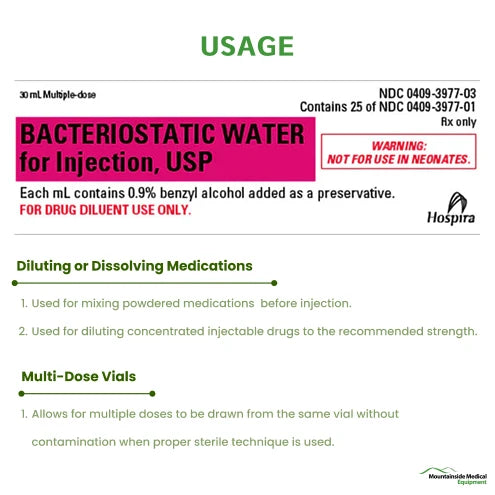
Key details to align with your purchasing checklist
- Form: Bacteriostatic Water Injection
- Vial size: 30 ml
- Packaging: 25 vials per pack
- Prescription: Rx
Choosing Between Bacteriostatic Water and Other Water Types
If you’re deciding whether bacteriostatic water is right for your use case, consider your draw pattern, your medication’s reconstitution instructions, and your facility’s operational constraints.
In the field, the comparison usually isn’t “which is better,” but “which is better for this workflow.” When I advise teams, I ask three questions:
- How many times will the vial be accessed? Multi-dose workflows often align naturally with bacteriostatic formulations.
- What do medication-specific instructions require? Reconstitution and storage guidance can override preferences.
- What is your wastage risk? Irregular administration can make larger multi-dose inventory harder to manage.
FAQ
What is “bacteriostatic water” used for in injection and compounding?
Bacteriostatic water is sterile water formulated with a bacteriostatic agent to inhibit microbial growth. It’s commonly used as the diluent for medication reconstitution when the intended workflow involves accessing a multi-dose vial under aseptic conditions and following medication-specific instructions.
Is mountainside medical bac water the same as sterile water?
No. “Mountainside medical bac water” refers to bacteriostatic water specifically. Sterile water is a different formulation, and the reconstitution instructions for your medication will determine which type is appropriate.
When would a 30 ml Hospira multiple-dose vial be a good fit?
A 30 ml multiple-dose vial can be a good fit when your facility performs frequent or predictable reconstitution draws, and your processes for aseptic technique, labeling, and time-to-use are well-defined to minimize waste and maintain consistency.
Conclusion
Bacteriostatic Water Injection—such as Hospira’s 30 ml multiple-dose vials—can support consistent reconstitution workflows when your medication instructions and facility SOPs align with multi-dose handling. The strongest results come from pairing the right water type with disciplined aseptic technique, careful compatibility checks, and practical inventory planning.
Next step: Review your current medication reconstitution instructions and compare them to your vial type and draw schedule—then standardize a quick “compatibility + aseptic + labeling” checklist for whoever prepares doses during the shift.
Discussion